BEAMING
In BEAMING, I explore the vestibular nature of ecosomatics—what I’ve come to understand as a transitional zone between formal dance training, choreographic innovation, and kinship to the natural world. This vestibule holds space for a new inquiry and it is one that is rooted in both light and presence.
BEAMING emerged from questioning how ecosomatics can exist outside of performances that are explicitly eco-activist. I argue that this state of vestibule is deep and rich in its stillness, but filled with an intensity of joy and aliveness.
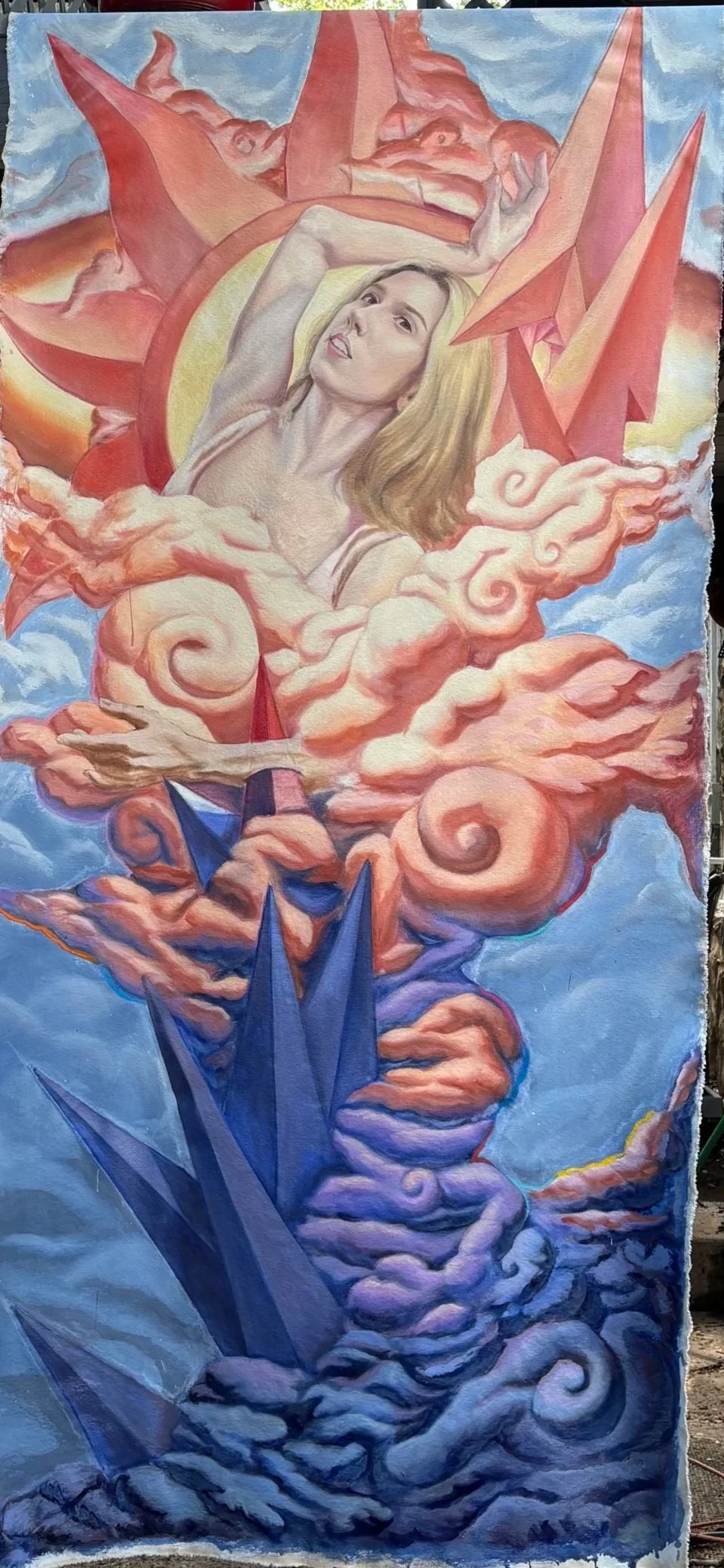
Painting by Timothy Hunter
Using Songs of Ascension by Meredith Monk alongside natural soundscapes, I work to embody the elements of the sky and exist inside a cloud code and light language. This coded language emphasizes parabolic upper body focus that juxtaposes the axial topography derived from floor bounded vocabularies present in my modern, postmodern, contemporary, and somatic training. I do not reject these forms but reorganize, compost, and erode them in my pursuit of radiance and beaming.
I position myself in a grid between two canvases which represent a landform gap that I implement for vertical exploration. My framing within the two canvases is in dialogue with Atlanta-based painter and chemist Timothy Hunter’s Kumo #1. The canvases act not as endpoints, but rather as a passageway to the environment of and inside the painting. As the piece progresses, my movement transforms into an inquiry of light. I see it not only as metaphor, but also material as I travel through the “clouds” and am diffused by them. The Cloud code aids in helping me find radiance as I break though the cloud barrier repurposing the canvas. I feel the effects of the landform gap that occurs between myself and the canvas, studio vs. natural environment, and my technical/aesthetic training with a newfound interest in ecosomatics. This work is a transformation into beaming through the body, through ecosomatic practice. Light does not only exist in the form of speed, but its most vibrant and powerful effects come through present stillness.
Questions that guided this work: Can we listen and learn from the gaps, the vestibule of ecology and somatic body/mind to find presence? Can my training serve as a conduit for ecosomatic becoming? Is it possible to move toward a practice where facility doesn’t default to spectacle, but instead acts as a utility for connection, one that in this work orients skyward without losing its grounding? What can ecosomatic dance offer for the continuation, evolution, and regeneration of contemporary concert dance?